Published by:
CGP EDU Academic Team
Published on: September 12, 2026
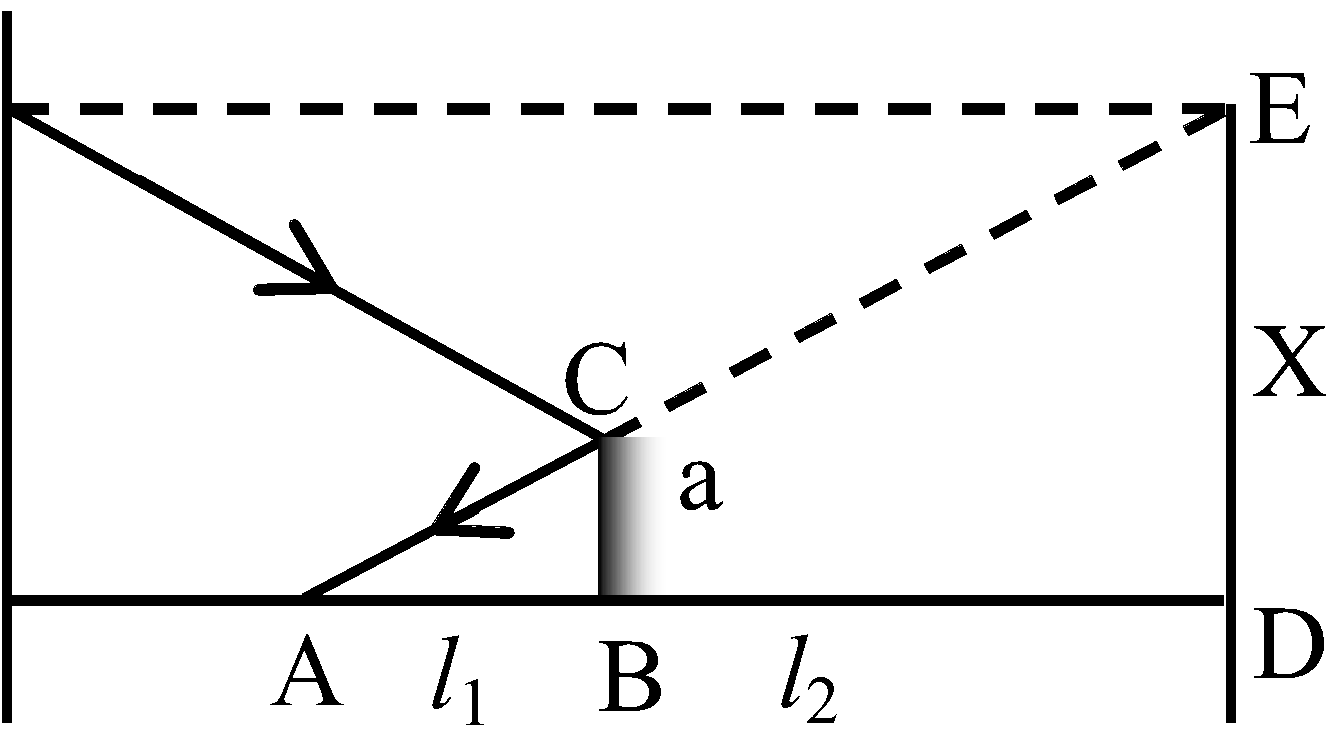
A mirror 1 m high hangs on a wall. A man stands a distance of 2 m away from the mirror. What is the height of the portion of the opposite wall in the room that can be seen by the man in the mirror without changing the position of his head? The wall is 4 m from the mirror.
Text Solution
Verified by ExpertsThe correct answer is:
B
Step 1: Understand the setup of the problem. The height of the mirror is 1 m and the man is standing 2 m away from the mirror.
Step 2: Identify the distances:
- Distance from the man to the mirror = 2 m
- Distance from the mirror to the wall = 4 m
Step 3: The total distance from the man to the wall where the mirror reflects the image = 2 m + 4 m = 6 m.
Step 4: Since the mirror is 1 m high, the man can see the image reflected at the same height due to light reflection principles.
Step 5: For the portion of the wall that can be seen, we can use similar triangles: the height of the reflected image from the man's eyes to the wall will be proportional to the distances involved.
Step 6: The proportion of height increase is determined by the distance ratios: If the man's line of sight down to the mirror reflects up to the wall, the visible height will scale with respect to those distances.
Step 7: Since the total line length is effectively doubled from 2 + 4 = 6 m, the height can also be noted as doubling the height of the mirror with respect to the angles formed in each triangle created by the mirror and the observer.
Step 8: Therefore, the height of the wall portion visible is height of mirror plus additional scaling into the distance, which is effectively mirrored as the observer is 6 m away and still able to see the 1 m height.
So effectively, the wall portion viewable would result to still remain at a 1 m height as the focal points remain aligned from point of viewing.
Therefore, the visible height of the portion of the opposite wall is effectively 1m reflected at position which means the answer height can be stated at respective positions due to reflections.
Step 2: Identify the distances:
- Distance from the man to the mirror = 2 m
- Distance from the mirror to the wall = 4 m
Step 3: The total distance from the man to the wall where the mirror reflects the image = 2 m + 4 m = 6 m.
Step 4: Since the mirror is 1 m high, the man can see the image reflected at the same height due to light reflection principles.
Step 5: For the portion of the wall that can be seen, we can use similar triangles: the height of the reflected image from the man's eyes to the wall will be proportional to the distances involved.
Step 6: The proportion of height increase is determined by the distance ratios: If the man's line of sight down to the mirror reflects up to the wall, the visible height will scale with respect to those distances.
Step 7: Since the total line length is effectively doubled from 2 + 4 = 6 m, the height can also be noted as doubling the height of the mirror with respect to the angles formed in each triangle created by the mirror and the observer.
Step 8: Therefore, the height of the wall portion visible is height of mirror plus additional scaling into the distance, which is effectively mirrored as the observer is 6 m away and still able to see the 1 m height.
So effectively, the wall portion viewable would result to still remain at a 1 m height as the focal points remain aligned from point of viewing.
Therefore, the visible height of the portion of the opposite wall is effectively 1m reflected at position which means the answer height can be stated at respective positions due to reflections.
Prepare Smarter with CGP Edu
Get practice questions, solutions, and test series in one place.
Write a Review
Share your experience with this question and solution.
Commentary
Send your comment, doubt, correction, or feedback to admin.
Similar Questions
Explore conceptually related problems
A student can distinctly see the object upto a distance 15 cm . He wants to see the black board at …
Two plane mirrors. A and B are aligned parallel to each other, as shown in the figure. A light ray …
A concave mirror of focal length is used to obtain the image of the sun which subtends an angle of…
A square of side is placed at a distance of from a concave mirror of focal length The centre of …
A thin rod of length lies along the axis of a concave mirror of focal length One end of its magni…
A ray of light falls on the surface of a spherical glass paper weight making an angle with the nor…